8 October 2026 - Cytara Chat with i
Austria’s New 2026 Parcel Tax: Who Is Really Paying the €2.40 Surcharge?
This transcript of today's Cytara Chat with i session explores Austria's new parcel tax.
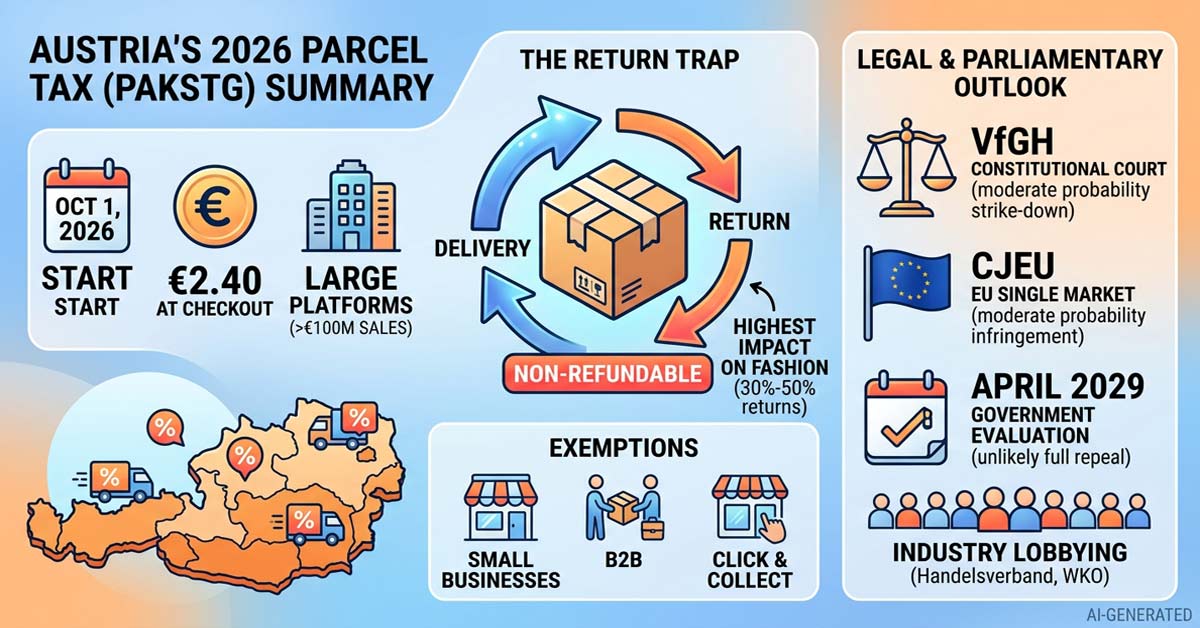 Image: An infographic summarizing Austria's 2026 Parcel Tax Act (PakStG). The graphic outlines key details including the October 1, 2026 start date, the €2.40 checkout surcharge, and the €100M platform sales threshold. It illustrates the "Return Trap" affecting fashion retail, exemptions for small businesses, and legal challenges before the Constitutional Court (VfGH) and EU CJEU ahead of the April 2029 government evaluation.
Quick Read
• Start & Cost: In effect since October 1, 2026, adding a €2.00 flat fee (**€2.40** with 20% VAT) to online consumer orders.
• Revenue Threshold: Applies only to retail giants exceeding **€100M** in annual Austrian turnover (e.g., Amazon, Zalando, Shein).
• The Return Trap: Charged at checkout and **non-refundable** on returned goods, hitting apparel retail exceptionally hard.
• Key Exemptions: Small businesses, B2B orders, grocery deliveries, and Click & Collect pickups pay €0.
| Cytara: What is the latest news regarding the new parcel tax in Austria? |
The Austrian Parcel Tax Act (Paketsteuergesetz or PakStG) took effect on October 1, 2026, enacted as part of the Budgetbegleitgesetz 2027–2028.
Core Details of the Law
- The Rate: €2.00 per delivered parcel (or optionally €2.00 per order for qualifying merchants). When passed along to consumers including Austria's 20% VAT, it adds €2.40 per order at checkout.
- Who Pays: The tax applies only to major e-commerce platforms and distance sellers whose net online B2C sales in Austria exceeded €100 million in the previous financial year. Around 16 major platforms meet this threshold, including Amazon, Zalando, Temu, Shein, MediaMarkt, IKEA, and AliExpress. Small and medium-sized online shops selling below the threshold are completely exempt.
- Trigger Point: Tax liability is triggered at checkout/payment acceptance—not upon physical delivery. Returned items do not cancel or refund the tax unless the parcel was never delivered (e.g., lost or refused).
Exemptions & Scope
| Category |
Status |
| B2C Online Deliveries |
Taxable (if seller exceeds €100M threshold) |
| B2B Deliveries |
Exempt |
| Click & Collect |
Exempt (picked up at the seller's physical store) |
| Fresh Food / Takeaway |
Exempt (standard grocery & meals delivery) |
| Letters & Newspapers |
Exempt |
Purpose & Revenue Allocation
- Expected Yield: The Ministry of Finance projects the levy to generate roughly €280 million annually.
- Policy Goals: The tax is meant to level the playing field for local brick-and-mortar retail, offset environmental impacts from high delivery volumes, and counter-finance lower VAT rates on basic foodstuffs.
A formal evaluation by the Ministry of Finance is scheduled for April 2029 to review its impact and decide whether to adjust the threshold.
| Cytara: Is the Austrian fashion industry affected by the new tax, and are there efforts to amend the law? |
Impact on the Austrian Fashion Industry
The fashion retail sector is heavily affected by the Paketsteuergesetz (PakStG) due to its exceptionally high order volumes, split shipments, and high return rates.
- Large Fashion Retailers: Major fashion platforms operating in Austria—including Zalando, Shein, Temu, Otto, and Amazon—exceed the €100 million revenue threshold and are subject to the tax. Most have opted to pass the cost directly to consumers at checkout as a €2.40 surcharge (net tax plus VAT).
- The "Return Trap": Under the law, tax liability is triggered at payment acceptance and cannot be refunded or corrected for customer returns. Because fashion e-commerce routinely experiences return rates between 30% and 50%, fashion platforms absorb or incur non-recoverable tax liabilities even on returned or exchanged apparel. Some retailers like Zalando and Otto are voluntarily absorbing the tax refund cost for customers on full returns as a competitive strategy.
- Domestic Austrian Brands & Boutiques: While small-to-medium domestic labels (e.g., local artisan brands, independent boutiques, and niche online shops) fall below the €100M threshold and are technically exempt, industry groups point out indirect market distortions:
- Small Austrian brands that sell via third-party marketplace platforms risk seeing their products hit with the surcharge because tax liability is determined by the platform's total turnover, not the merchant's.
- Domestic platform alternatives (e.g., shöpping.at) under the threshold are heavily marketing themselves as "parcel-tax-free" to attract local fashion sellers and buyers.
Efforts to Amend, Challenge, or Repeal the Law
Given that the law only came into effect on October 1, 2026, political and legal friction is active on multiple fronts:
1. Pending Legal Challenges & Constitutional Appeals
Major online retailers, trade associations, and corporate legal groups (including Otto Austria and representatives from international fashion logistics) are preparing legal challenges. Arguments center around:
- EU Single Market Violations: Critics argue the law penalizes cross-border distance sales and discriminates based on company size/revenue thresholds.
- Constitutional Equal Treatment (Gleichheitsgrundsatz): Opponents argue that charging an unrefundable tax on returned goods creates an unlawful distortion and arbitrary tax burden. Lawsuits are expected to escalate to the Austrian Constitutional Court (VfGH) and potentially the Court of Justice of the European Union (CJEU).
2. Industry Association Lobbying (WKO & Handelsverband)
The Austrian Retail Association (Handelsverband) and the Austrian Federal Economic Chamber (WKO) have criticized the tax as overly bureaucratic. Key demands presented to the Federal Ministry of Finance include:
- Exempting Returns: Introducing an amendment to allow tax write-offs or credits when items (such as clothing sizes) are returned.
- Marketplace Clarifications: Refining "deemed-supplier" rules so that small domestic fashion brands selling through large marketplace software are not unfairly penalized.
3. Government Review Timeline
The Federal Ministry of Finance has built a mandatory evaluation clause into the legislation scheduled for April 2029. Legislative amendments prior to that window will depend on court rulings or significant economic pushback during upcoming parliamentary budget reviews.
| Cytara: What does the Government Review Timeline mean - explain it. |
The Government Review Timeline (also called the evaluation clause) is a built-in legal requirement written into section 17 of the Paketsteuergesetz.
It requires the Austrian Federal Ministry of Finance to conduct an official study reviewing how the parcel tax operates in practice and submit a report to the Austrian Parliament by April 30, 2029.
What the Review Will Evaluate
- Revenue Generated: Whether the tax actually brought in the expected ~€280 million per year.
- Economic & Market Impact: How the surcharge influenced consumer spending habits, brick-and-mortar retail sales, and platform behavior.
- The Revenue Threshold: Whether the current €100 million sales threshold is setting the right boundary or if it should be adjusted.
Why This Mechanism Exists
- Sunset/Revision Pressure: When governments introduce novel taxes (especially targeted levies like this one), lawmakers include evaluation clauses to ensure new legislation doesn't permanently disrupt markets without oversight.
- Testing Market Distortions: It allows the state to monitor unintended side effects—such as large platforms passing fees down to small marketplace merchants or international legal challenges—and decide if statutory changes are necessary.
What It Means for the Market
- In the Short Term (2026–2028): The law remains fixed as written unless struck down early by the courts (e.g., the Constitutional Court or CJEU).
- In 2029: The report will dictate whether Parliament:
- Lowers the threshold: Lowering the €100M cap would bring mid-sized retailers and regional fashion brands directly into the tax scope.
- Fixes operational issues: Introducing specific amendments, such as exemptions or tax credits for customer returns.
- Leaves it as-is or repeals it: Based on its impact on local trade and overall revenue goals.
| Cytara: How likely is it that the law will be stopped before April 2029? |
Whether the law will be stopped or substantially amended before April 2029 depends on legal challenges rather than political repeal.
A complete legislative repeal by the Austrian Parliament before 2029 is unlikely, but an invalidation or modification by judicial intervention holds a moderate probability.
Key Pathways & Probability Breakdown
1. Constitutional Court Invalidation (Moderate Likelihood)
- The Claim: Retailers (including Zalando, who filed an appeal with the Verfassungsgerichtshof in August 2026) argue the tax violates the constitutional principle of equal treatment (Gleichheitsgrundsatz).
- The Flaw: By taxing non-refundable checkout transactions even when goods are returned, the law imposes a tax liability where no actual consumer delivery/consumption remains. Furthermore, applying a flat €2.00 fee regardless of order value creates disproportionate burdens (e.g., a 24% tax on a €10 item vs. 1% on a €200 item).
- Timeline: VfGH decisions typically take 12 to 18 months, meaning a ruling could land between late 2027 and 2028.
2. European Union Law Intervention (Moderate Likelihood)
- The Claim: Trade bodies like the Handelsverband and Ecommerce Europe are targeting EU infringement mechanisms.
- The Flaw: Because the €100M threshold targets major distance sellers (mostly foreign platforms shipping into Austria), opponents argue it functions as a disguised restriction on the free movement of goods within the EU Single Market.
- Timeline: If the European Commission launches formal infringement proceedings or refers the issue to the Court of Justice of the European Union (CJEU), interim injunctions or forced statutory revisions could occur within 2 to 3 years.
3. Austrian Parliamentary Repeal (Low Likelihood)
- Budget Dependency: The government relies heavily on the estimated €280 million annual revenue from the tax to offset the concurrent VAT reduction on basic foodstuffs.
- Political Capital: Repealing the tax early would create a €280M hole in the federal budget, making a voluntary political repeal prior to the mandatory April 2029 review structurally improbable unless dictated by court order.
Summary Outlook
| Pathway |
Primary Mechanism |
Likelihood Before April 2029 |
Expected Timing |
| Constitutional Court Strike-Down |
Invalidation of return tax rules or total law (VfGH) |
Moderate (~40%) |
2027 – 2028 |
| EU Law Infringement |
CJEU / EU Commission Single Market enforcement |
Moderate (~35%) |
2028 |
| Targeted Statutory Amendments |
Parliament fixes return rules under legal pressure |
High (~60%) |
2027 – 2028 |
| Full Parliamentary Repeal |
Voluntary legislative cancellation |
Low (<10%) |
Post-2029 review |
|